Research methodology and methods
Welcome
Welcome
Welcome! Click the tabs below for more information about the structure of this course, the authors and contributors, and what you can expect to gain from the course.
When you are ready to begin, please proceed to the 'Introduction' page.
Research and Writing Skills for Dissertations and Projects: An Introduction
Research methodology and methods
www.epigeum.com

1/5
Dr Catherine Alexander: Author
Catherine Alexander is a social geographer and Development Officer for the Participatory Research Hub at Durham University. Her research interests focus on youth, social justice and the city in 'Assembling fear, practising hope: geographies of gender and generation in Newcastle upon Tyne'. Catherine has extensive experience in qualitative, participatory and action research both in the UK and Europe.

2/5
Dr Nicholas Walliman: Lead advisor (1)
Nicholas Walliman is a qualified architect, Senior Lecturer in the School of the Built Environment at Oxford Brookes University and a research associate in the Oxford Institute for Sustainable Development. After many years of practice in architecture in the UK and abroad, he returned to academic life to do his PhD. He has subsequently published a number of books on research theory and methods, and writing dissertations and theses, aimed at students and practitioners from undergraduate to doctoral levels of expertise.
He is currently conducting research with a team of architects and environmental scientists as part of the Oxford Brookes Institute for Sustainable Development who are engaged in nationally and internationally funded projects on a range of aspects of building technology. He has published numerous research papers and is also supervising several PhD and master's students.

3/5
Professor Gina Wisker: Lead advisor (2)
Gina Wisker is Professor of Higher Education and Contemporary Literature at the University of Brighton, where she is Head of the Centre for Learning and Teaching. Her principal research interests are in learning and teaching, specialising in postgraduate study and supervisory practices.
Among a number of external roles, Gina is part of the management team for the Scholarship of Teaching and Learning (SoTL) research project, chairs the Staff and Educational Development Association (SEDA) Scholarship and Research Committee and the Contemporary Women's Writing Association. She is chief editor of SEDA's journal Innovations in Education and Teaching International and serves on publications and fellowships committees.
Gina has been chair and co-chair of the Heads of Education Development Group (HEDG), and a founder member of the HEDG Planning group. She is a member of the International Consortium for Educational Development (ICED) and the Higher Education Learning and Teaching Association of South Africa (HELTASA).

4/5
Mandy Asghar: Reviewer
Mandy Asghar is the Director of the Academic Development Directorate and Associate Professor at York St John University. She achieved recognition as a Principal Fellow of the Higher Education Academy (HEA) in 2013.
Mandy has a strategic role to ensure that students are provided with high-quality, contemporary and evidence-informed learning experiences. Her directorate's focus is to enhance pedagogic practice through educational development and curriculum innovation projects that inspire a creative approach to enhancing student learning.
Mandy also leads research development for postgraduate students and staff. Her own research and publications are in the area of formative assessment and student engagement in service learning. She is currently chair of a national network, the Heads of Educational Development Group.

5/5
Wilma Alexander: Accessibility Advisor
Wilma Alexander has recently retired from the University of Edinburgh, where she was part of the central e-learning team for over 15 years. During that time she promoted the importance of usable and accessible digital practice, tutored on the groundbreaking master's degree in Digital Education, and developed online staff training on accessible e-learning and online tutoring skills. Since 2007 she has worked with Epigeum, now part of Oxford University Press, on improving the accessibility features of their courses, and on ensuring content emphasises accessibility and usability where appropriate. Wilma is a Fellow of the Higher Education Academy and has a master's degree in Human-Computer Interaction and Information Science.
The diagram below explains the chronology of the module.
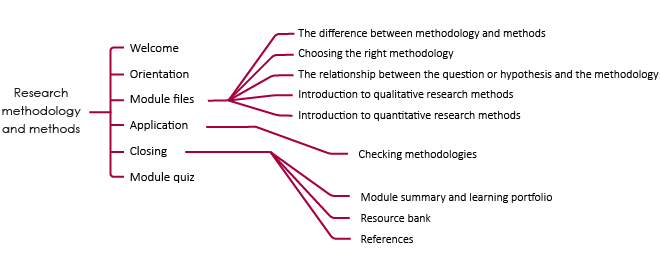
Module highlights include:
- Activities to help you to decide on the most effective approach to your research question or hypothesis
- Useful resources for defining research questions or hypotheses
- Information and resources to guide you through different approaches to your research.
The Research and Writing Skills for Dissertations and Projects: An Introduction programme has been developed in conjunction with the following institutions:
- Beijing Normal University, China
- Cranfield University, UK
- University College London, UK
- University of Antwerp, Belgium
- University of Canberra, Australia
- University of Newcastle, Australia.